What you will see
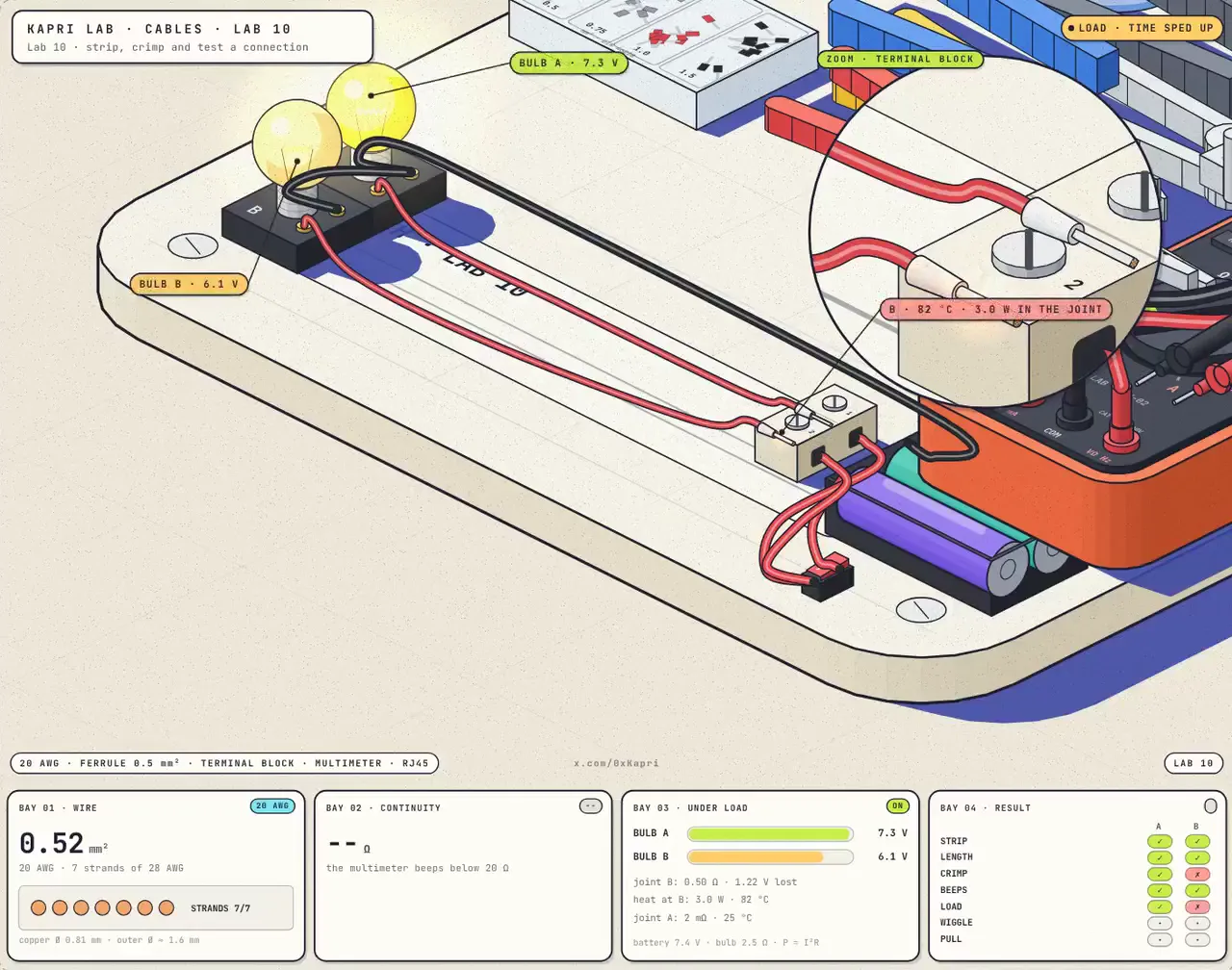
Five sections: strip (the notch for the gauge cuts only the insulation), length (9-10 mm for a 0.5 mm² ferrule), crimp (loose, over-crimped and correct, seen in cross-section), test (continuity, load, wiggle and pull) and network (UTP with 4 twisted pairs, T568B order and an RJ45 tester).
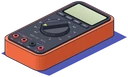
Both wires beep on the multimeter, but under load the loose crimp loses voltage and heats up, flickers when you wiggle it and comes out in the pull test. The knob changes the resistance of that loose joint. Readings come from a simple model: the assumptions are in the note.
Model note
What the lab assumes and where its numbers come from.
Data: 20 AWG = 0.518 mm² and 0.812 mm of copper (AWG table, Engineering ToolBox); the gauge is not the outer diameter of the cable. 0.5 mm² insulated ferrule (WAGO 216-201): 8 mm sleeve, strip 9-10 mm. A loose crimp leaves voids between strands and raises resistance; an over-crimp damages strands (TE, Molex, IPC/WHMA-A-620). Minimum pull for 20 AWG: 13 lb (UL 486, Checkline table); it is a mechanical check, not the only one. The meter beeps below 20 Ω (Fluke 115), so a loose joint also beeps. T568B: white-orange, orange, white-green, blue, white-blue, green, white-brown, brown; untwist at most 13 mm (TIA-568 via Fluke Networks); a split pair passes continuity and fails NEXT (Fluke Networks). Model assumptions: 1.6 mm outer diameter, 7 strands of 28 AWG; 2× 18650 pack at 7.4 V; bulb modeled as a fixed 2.5 Ω; 1 m of 20 AWG (33 mΩ); good joint 2 mΩ, loose joint 0.5 Ω (knob 0.1-1.0 Ω); joint heat P = I²R with Rθ = 30 K/W and sped-up time; bulb brightness proportional to (I/I_A)^3.4; wiggling opens the contact now and then. Tools and tester are original designs, not a real brand. Made by @0xKapri.
Sources
- 0120 AWG = 0.518 mm² and 0.812 mm of copper; 33.3 mΩ per meter. Engineering ToolBox AWG table and Farnell AWG calculator.
- 020.5 mm² insulated ferrule: 8 mm sleeve, strip 9-10 mm. WAGO 216-201 datasheet.
- 03A loose crimp leaves voids and raises resistance; over-crimping damages strands. Molex in Electronic Design and TE crimp quality guide.
- 04Minimum pull for 20 AWG: 13 lb per UL 486. Checkline requirements table.
- 05The Fluke 115 beeps in continuity below 20 Ω. Fluke 115 datasheet.
- 06T568B order, untwist at most 13 mm, and a split pair passes continuity but fails NEXT. Fluke Networks and Monoprice.