What you will see
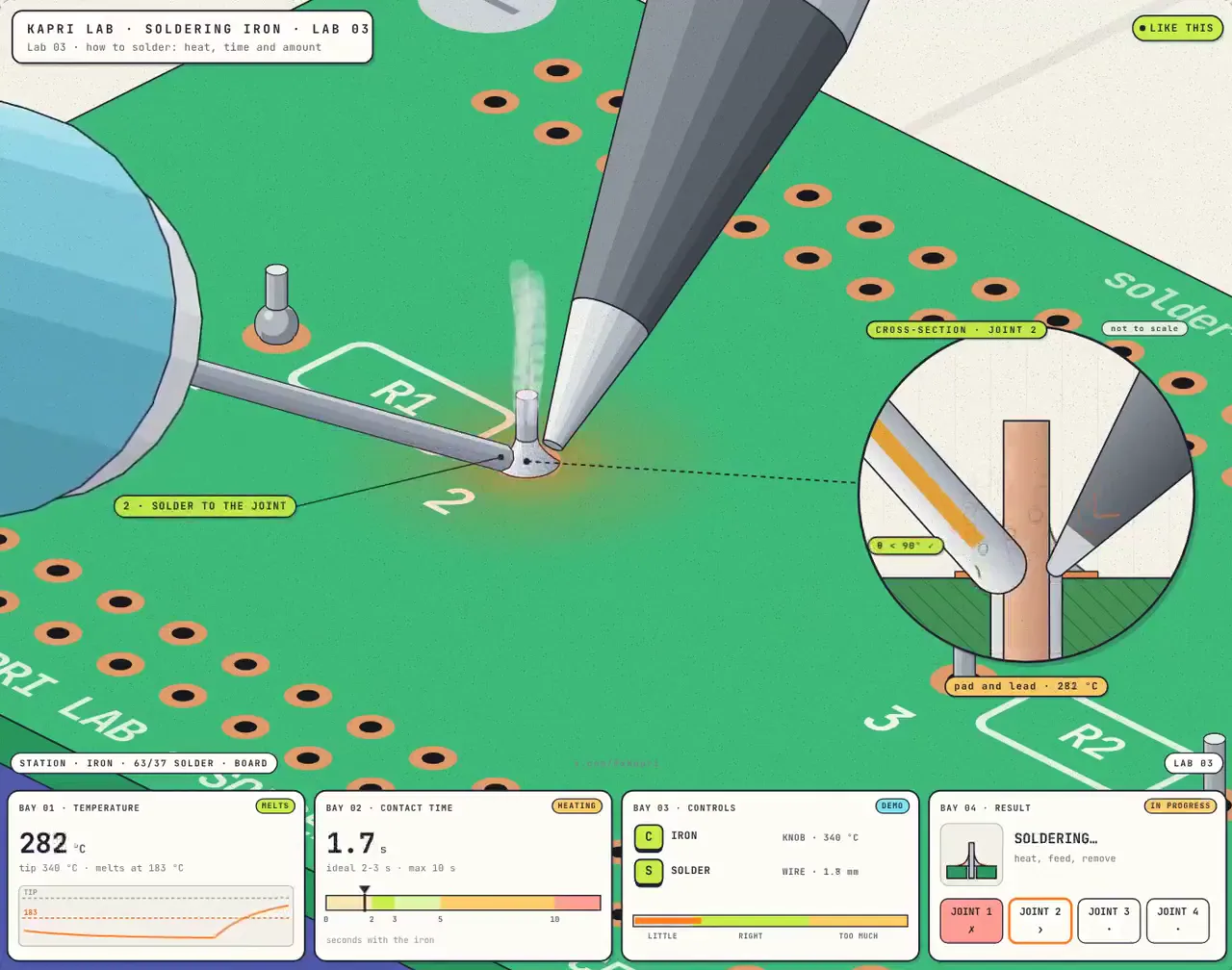
Four chapters: you set the iron to 340 °C, then see a bad joint (solder on the tip leaves a cold blob), a good one (pad and lead melt the wire and you get a volcano) and one with too much heat (over 10 s lifts the pad). The last one is sped up ×4.
Then you drive it: hold C to touch with the iron and S to feed solder, and turn the knob to set the tip from 200 to 450 °C. After each joint it tells you if you got a volcano, a cold blob or a lifted pad. The model is simplified: the assumptions are in the note.
Model note
What the lab assumes and where its numbers come from.
Data: Sn63Pb37 solder melts at 183 °C (eutectic; MG Chemicals and Kester datasheets). Tip at 315-371 °C for 63/37, heat the pad and lead and do not put the wire on the tip (Kester 245 datasheet); here the tip runs at 340 °C. Heat pad and lead for 1-2 s and bring the solder to the joint (Adafruit, iFixit, allPCB). Wetting angle under 90° = good joint (IPC-A-610). Ideal contact 2-3 s (JLCPCB, iFixit), under 5 s (onsemi); over 10 s risks the pad (iFixit, onsemi). Model assumptions: the joint heats toward the tip temperature with a 1.0 s time constant and cools with 1.5 s; 0.8 mm wire fed at 3 mm/s; a complete joint takes 1.5-4.5 mm of wire on a 2 mm pad; flux burns faster with more heat and pad damage grows with (T - 200 °C) until it lifts near 10 s at 340 °C. Chapter 4 time is sped up ×4. Station and tools are custom designs, not a real brand. Made by @0xKapri.
Sources
- 01Sn63Pb37 melts at 183 °C (eutectic). MG Chemicals datasheet and Kester alloy table.
- 02Tip at 315-371 °C for 63/37 and do not put the wire on the tip. Kester 245 datasheet (text quoted on the Parallax forum, not the PDF).
- 03Heat pad and lead 1-2 s, ideal contact 2-3 s, and over 10 s risks the pad. iFixit, Soldering Tips (and JLCPCB, 12 Professional Soldering Tips).
- 04A joint in under 5 s. onsemi application note AND90331.
- 05Wetting angle under 90° = good joint. IPC-A-610, explained by Bittele.
- 06The solder goes on the side opposite the iron. Adafruit, Guide to Excellent Soldering.