What you will see
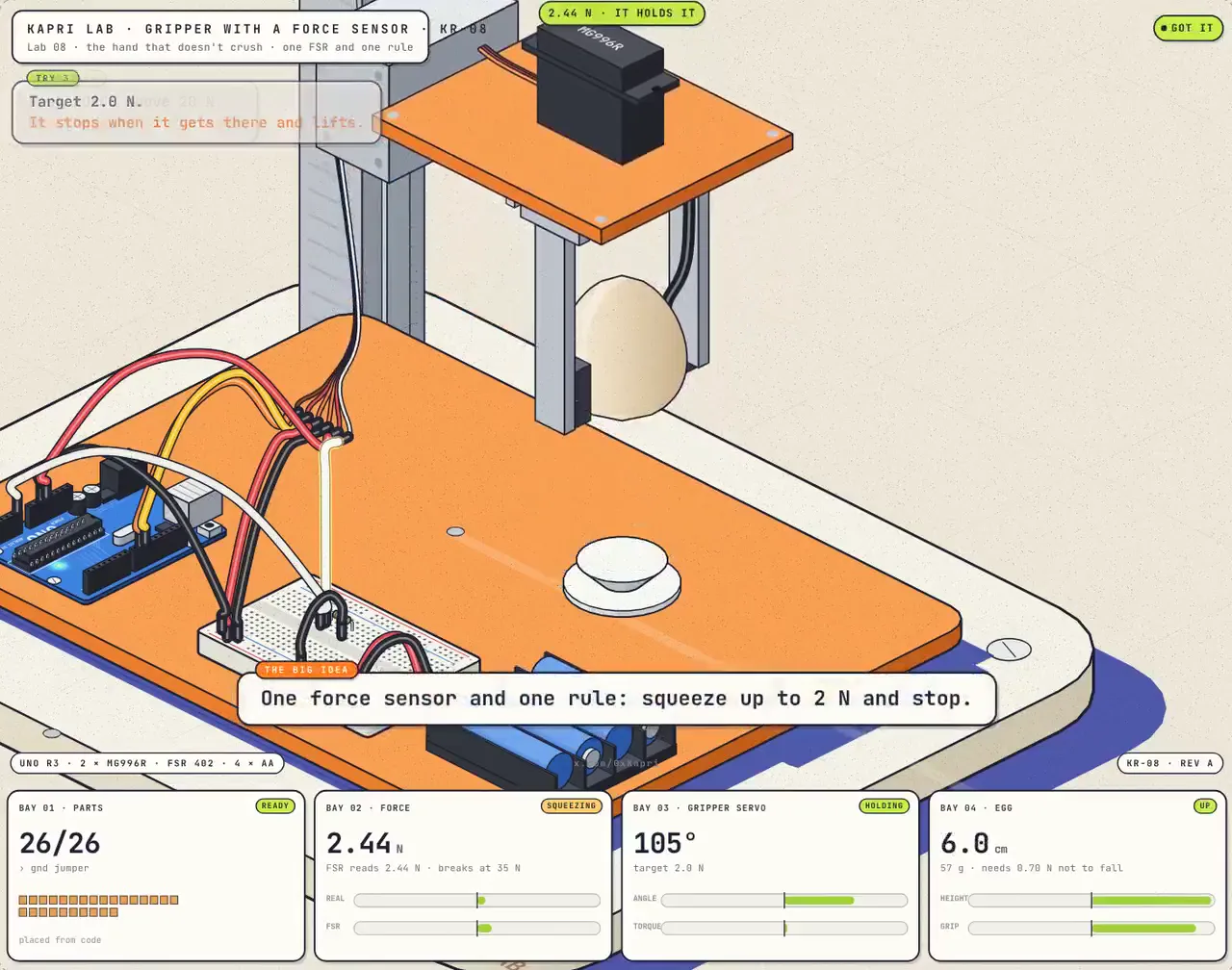
It builds itself: a gripper with two MG996R servos (one closes, one lifts), an FSR 402 force sensor on one jaw, an Arduino UNO, 4 AA batteries and a large 57 g egg.
Try 1, no sensor: pinza.write(180) closes all the way, in slow motion. The servo can push 108 N and the egg breaks at 35 N. Try 2: with the FSR and a 0.2 N target (the least it can read) it stops at 0.44 N and, when it lifts, the egg slips: it needs 0.70 N. Try 3: with 2 N it lifts it 6 cm.
Then you take over with the FORCE knob. Careful: above 20 N the FSR can't read any higher, the gripper keeps squeezing and the egg breaks even with a sensor. The model is simplified: the assumptions are in the note.
Model note
What the lab assumes and where its numbers come from.
Model: gripper with an MG996R servo (11 kgf·cm at 6 V) and a 1 cm pinion, an FSR 402 sensor (reads 0.2 to 20 N) on one jaw, and a large 57 g egg that breaks at about 35 N. Assumptions: foam that squeezes 3 N per mm, foam-shell friction of 0.4, and an FSR that reads the true force between 0.2 and 20 N. To avoid slipping: m·g / (2·μ) = 0.70 N. The sketch closes 1° every 20 ms until the FSR reaches FORCE, then lifts 6 cm.
Sources
- 01MG996R: 9.4 kgf·cm at 4.8 V and 11 kgf·cm at 6 V, 0.14 s per 60° at 6 V, 40.7 × 19.7 × 42.9 mm. TowerPro datasheet.
- 02FSR 402: reads from about 0.2 N up to 20 N. Interlink Electronics datasheet, FSR 400 series.
- 03A hen's egg squeezed between two plates breaks at about 35 N on average. US patent 10458888.
- 04Large egg: a dozen weighs at least 24 oz, about 57 g per egg. USDA size chart.
- 05108 N, 0.44 N, 0.70 N and 2.44 N come from the model.