What you will see
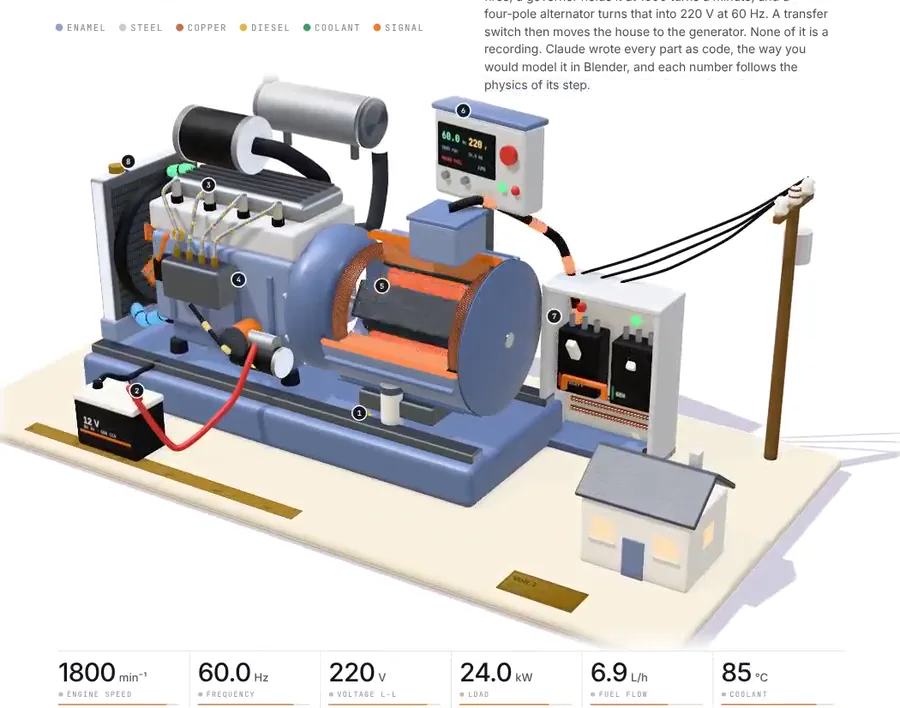
Six stations on a dial: crank (the 12 V battery spins the engine to about 200 rpm), fire (the diesel lights by compression and the governor holds 1800 rpm), excite (the AVR brings the alternator to 220 V and 60 Hz), transfer (opens the dead grid and closes the generator), load (24 kW hits the shaft, speed dips and recovers) and cool (radiator and fan).
Every part is modelled as code and the readings follow the physics of each step: f = poles × rpm / 120, and fuel use comes from the energy in diesel and the engine efficiency. The assumptions are in the note.
Model note
What the lab assumes and where its numbers come from.
Model: f = poles x rpm / 120 (4 poles, 1800 rpm = 60 Hz). Load 24 kW (80 % of 30 kW). Fuel = 0.9 L/h at no load + kW / (0.35 x 9.9 kWh/L) x 0.87. Speed dip on the load step: 1.9 %, recovered in about 1 s (assumption). Warm-up shown as a time-lapse. Shaft rotation shown slower so the eye can follow it.
Sources
- 01Frequency of a synchronous generator: f = poles × rpm / 120 (4 poles, 1800 rpm = 60 Hz). Iowa State, EE303.
- 02NFPA 110 Type 10: power back within 10 s at most. Cummins, PowerHour NFPA 110.
- 03Energy in diesel: 128,488 Btu/gal (9.95 kWh/L). AFDC, U.S. Department of Energy.
- 04Fuel use of a 30 kVA generator at 60 Hz: 6.6 L/h at 75 %. Cat XQP30.
- 05Minimum cranking speed of a diesel: about 150 rpm. Mitchell 1.