What you will see
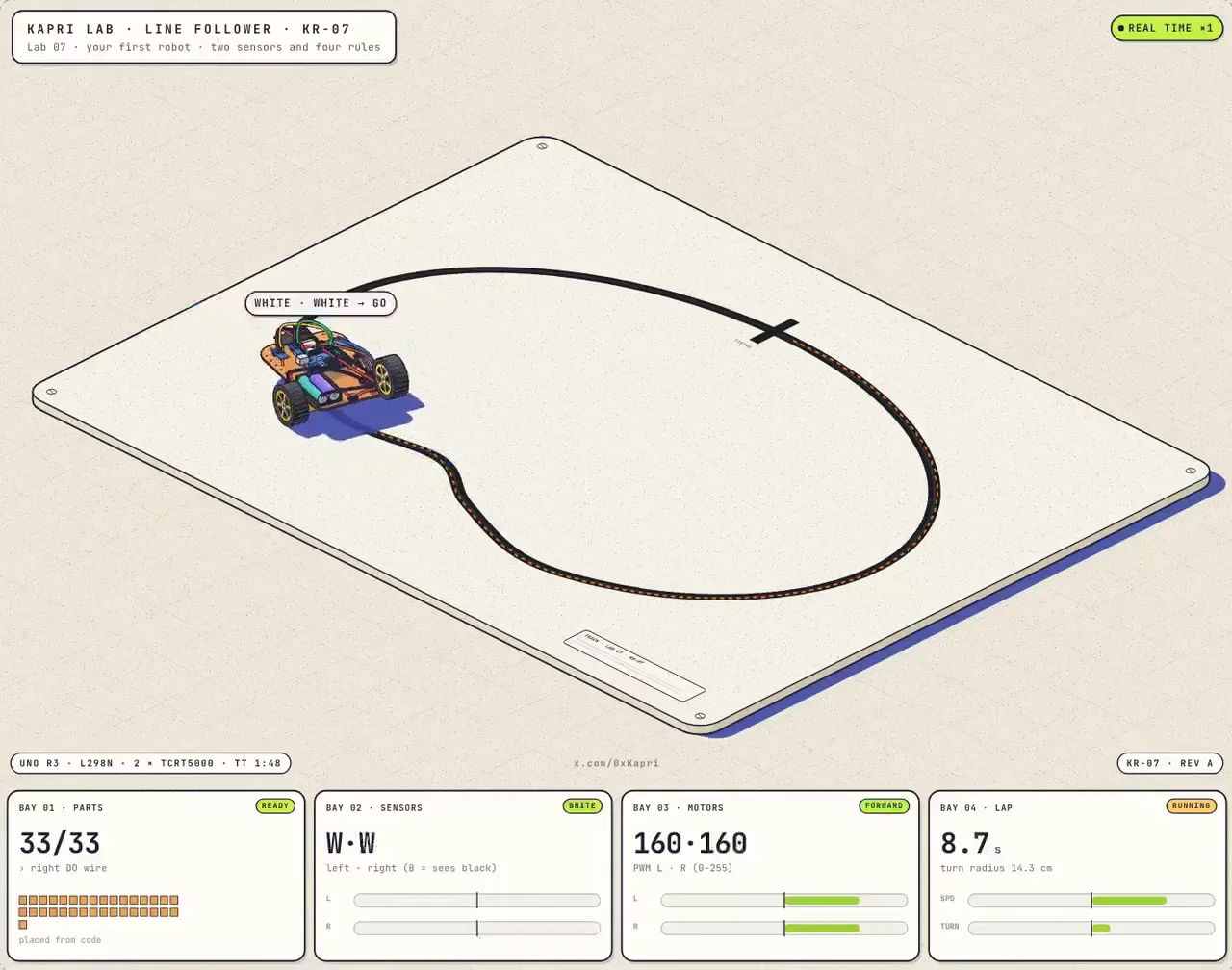
It builds itself, piece by piece: Arduino UNO, L298N H-bridge, 2 TT motors and 2 TCRT5000 sensors up front. On white the infrared bounces back and the sensor sends LOW; on the black tape it gets swallowed and the sensor sends HIGH.
First try: the inner wheel barely slows down (TURN 110), the turn radius comes out at 46 cm and the robot leaves the track. Second try: with TURN 40 the radius drops to 14 cm and it completes the lap in 12.5 s, all the way to the finish.
Then it is your turn: move SPEED and TURN and find out how tight a curve it can take. The model is simplified: the assumptions are in the note.
Model note
What the lab assumes and where its numbers come from.
Model: two TCRT5000 sensors (950 nm infrared, 0.2 to 15 mm range) 6.5 mm above the floor and 3 cm apart; 19 mm black tape; 65 mm wheels 17.2 cm apart; the sketch reads the sensors every 10 ms. Assumptions: 25 cm/s at PWM 150, speed proportional to PWM and motors that take 60 ms to respond. Turn radius: R = (17.2 / 2) × (vo + vi) / (vo − vi). Move SPEED and TURN and see if it finishes the lap.
Sources
- 01TCRT5000: 950 nm infrared, 10.2 × 5.8 × 7 mm, works from 0.2 to 15 mm. Vishay datasheet (doc. 83760).
- 02LM393 module: on a reflective (white) surface the DO output goes LOW and its LED turns on; on black it goes HIGH. ProtoSupplies and OSOYOO guides.
- 03The 46 cm radius (TURN 110), 14 cm (TURN 40), leaving the track at 3.5 s and the 12.5 s lap come from the model with the kit measurements.