What you will see
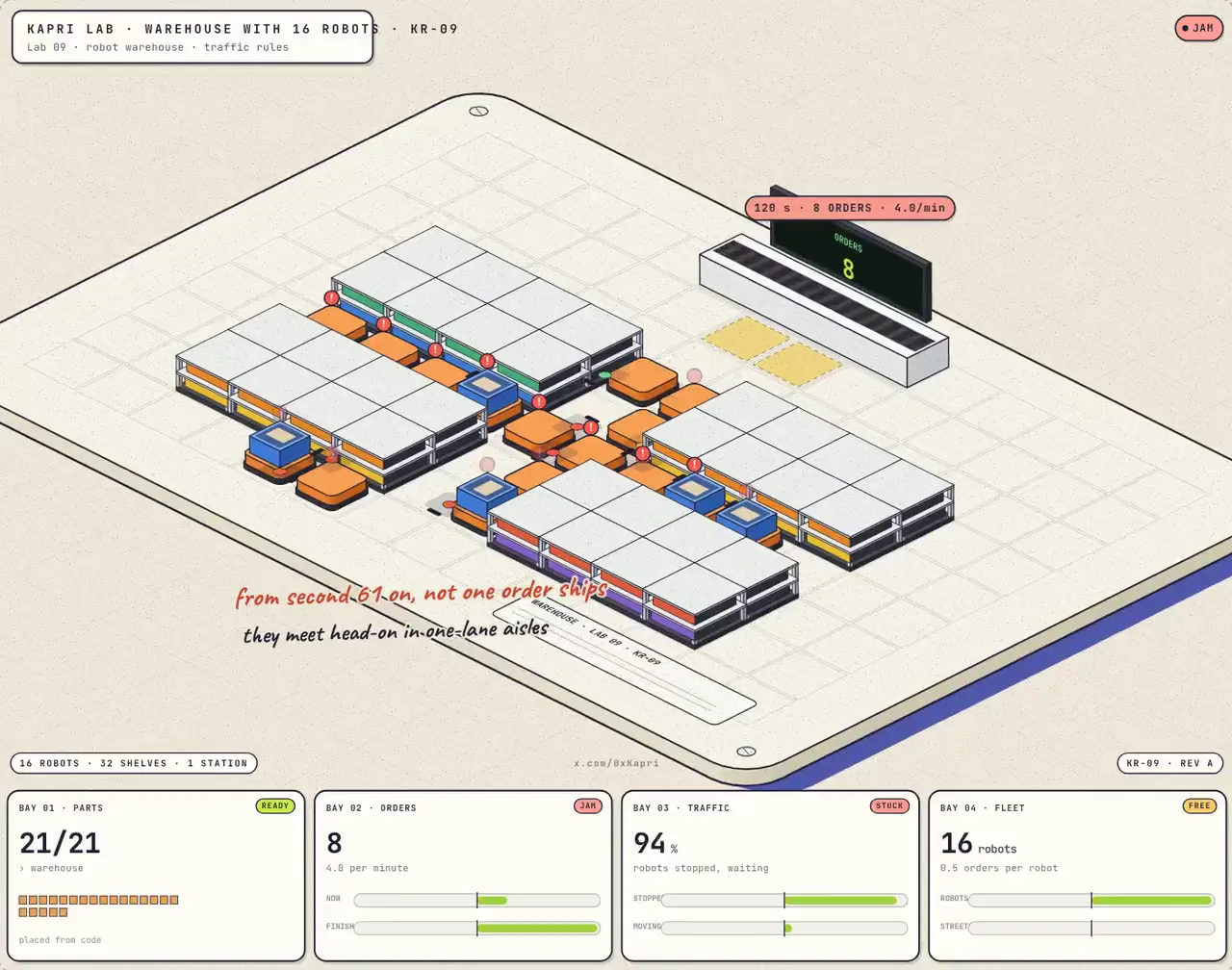
A 14 × 9 cell warehouse with 32 shelves, a packing station and up to 16 robots that carry each order from a shelf to the station. Each try is 2 minutes of warehouse time, sped up ×15.
Try 1: 6 robots, each goes wherever it wants, and 16 orders ship. Try 2: 16 robots with the same rules: they meet head-on in one-lane aisles and from second 61 on not one order ships; they end with 8. Try 3: one-way streets get painted and the same 16 robots ship 31.
Then you take over with two knobs, ROBOTS and STREETS, to find where the jam starts. It is a toy warehouse: the numbers come from this model, not from Amazon.
Model note
What the lab assumes and where its numbers come from.
Toy model: a 14 × 9 cell warehouse (1 cell = 1 m), robots at 1 cell per second, 3 s to pick and 3 s to drop an order, random orders with a fixed seed, 2 minutes per try. Every second each robot moves toward its goal if the cell is free; after 3 s stuck it looks for a way around or, if two meet head-on, the higher number backs up. With 1 to 4 robots free streets are a little faster (shorter routes); rules win when there is traffic.
Sources
- 01Amazon passed its one millionth robot and its DeepFleet model improves fleet travel time by 10%. Amazon, July 2025.
- 02Amazon bought Kiva Systems, the robots that carry shelves, in 2012 for 775 million dollars.
- 0316, 8 and 31 orders come from this warehouse model, not from a measurement.